Introduction
Picture this: a procurement manager walks into annual carrier negotiations armed with last year's invoices and a rough sense that rates "feel high." The carrier presents a 5.9% rate increase — the same average FedEx and UPS applied for 2024 — and without data to push back, the shipper accepts it. The meeting ends in 20 minutes.
Now picture the same shipper walking in with lane-level benchmark comparisons, a carrier performance scorecard showing 88% on-time delivery against a 95% industry average, and three competing quotes on their highest-volume lanes. That's a different conversation entirely.
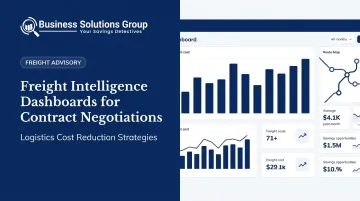
Freight intelligence dashboards exist to make the second scenario the norm. They consolidate rate data, carrier performance metrics, spend patterns, and market benchmarks into a single visual interface — giving shippers the evidence to negotiate from a position of strength rather than gut feel.
What follows covers what these dashboards actually track, how they shift negotiation dynamics, and what to look for when choosing the right solution.
Key Takeaways
- Freight intelligence dashboards centralize rate data, carrier performance, and spend analytics into one source of truth for contract negotiations
- Shippers with benchmark data and lane-level analysis consistently secure better pricing than those relying on historical invoices
- Effective freight contract management depends on dashboard intelligence across visibility, performance tracking, compliance, and renewal readiness
- Without these tools, shippers commonly overpay through missed renewals, unchallenged surcharges, and no negotiating leverage
- Choosing the right solution requires evaluating benchmark data quality, integration depth, and advisory support availability
What Is a Freight Intelligence Dashboard?
A freight intelligence dashboard is a centralized analytics platform that aggregates data from carrier contracts, rate sheets, shipment history, and market benchmarks into a single interface. The key word is proactive — this is not the reporting screen buried inside a TMS that tells you what happened last quarter. It's a tool oriented toward what you should do next, particularly in contract negotiations.
Standard TMS reporting is operational: it tracks shipments, generates invoices, and measures delivery performance against scheduled times. A freight intelligence dashboard goes further. It compares your contracted rates against current market benchmarks, flags where you're overpaying, and surfaces the evidence you need to challenge pricing before you sign the next contract cycle.
Who Uses It — and Why the Shared View Matters
Three departments typically rely on these dashboards, each with different needs:
- Procurement teams identify lanes where contracted rates exceed market averages
- Logistics managers track carrier service levels against contracted SLAs
- Finance teams validate invoices against negotiated rates and catch billing discrepancies before they compound
The strategic value is in the shared, consistent dataset across all three. When procurement, logistics, and finance are working from the same numbers, the organization negotiates as one unit — not three departments with conflicting spreadsheets.
That shared visibility has real dollar stakes. Freight rates fell 7% in 2024 after a 14% decline in 2023, yet many shippers on long-term contracts didn't capture those savings — their agreements auto-renewed without renegotiation. Fuel surcharge volatility compounds the problem: accessorial costs now shift as unpredictably as base rates. Without current market data in hand, shippers are negotiating blind.
Key Metrics a Freight Intelligence Dashboard Should Track
Not all dashboards are built equally. The ones worth investing in surface five categories of data that directly translate to negotiation leverage.
Lane-Level Rate Benchmarking
This is the foundation. The dashboard should display your contracted rates on specific trade lanes compared to current market averages, broken down by carrier, mode, and service type.
Knowing you're paying above market on your Chicago–Dallas lane is a negotiation opening. Knowing you're below market on your Atlanta–Miami lane tells you that's not where to push. Without lane-level benchmark data, you're pushing on the wrong lanes — and leaving the real savings on the table.
Carrier Performance Scores
Dashboards should display on-time delivery rates, damage frequency, and SLA compliance by carrier over rolling time periods — not just a single snapshot. If a carrier charges a premium rate but delivers at 88% on-time against a 95% industry benchmark, that performance gap is direct leverage. You're paying more and getting less. That's the conversation to have.
Spend Concentration and Volume Analysis
Total freight spend broken down by carrier, lane, mode, and time period reveals where your volume is concentrated. Shippers who can show a carrier "you represent 40% of our spend on this lane" have genuine leverage to negotiate tiered pricing. Shippers who can't quantify that concentration lose one of their strongest bargaining chips before the conversation starts.
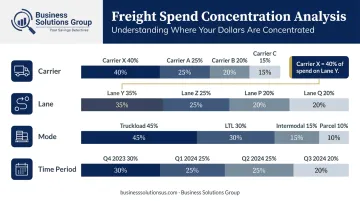
Business Solutions Group's Parcel Spend Intelligence platform surfaces exactly this data — consolidated by carrier, lane, and mode — so shippers can identify where volume concentration creates pricing leverage before they enter a negotiation.
Accessorial and Surcharge Tracking
Base rates are rarely the full story. Fuel surcharges, detention fees, lift-gate charges, and residential delivery fees can add substantially to total freight costs above contracted rates. A dashboard that tracks accessorial trends separately from base rates allows shippers to negotiate caps or clearer terms on charges that are often buried in carrier tariffs.
Contract Renewal and Expiration Visibility
A good dashboard maintains a live renewal calendar, flagging contracts approaching expiration 90–120 days out — with performance data and rate benchmarks pre-populated so you're ready to negotiate, not scrambling to pull data together. This single feature prevents the most common and costly mistake in freight procurement: the auto-renewal.
How Freight Intelligence Dashboards Strengthen Contract Negotiations
Data changes the negotiation dynamic in ways that preparation alone cannot.
Replacing Opinion with Evidence
"We feel your rates are too high" is a subjective complaint. "Your on-time rate on this lane is 88%, your contracted rate is 12% above the current market average, and we have two carriers offering lower rates with better performance scores" is a documented business case.
Carriers are experienced negotiators. Opinions don't move them. Evidence does.
Benchmark-Based Rate Challenges
Rate benchmarking enables a specific, repeatable tactic: identify lanes where your contracted rate materially exceeds market, quantify the gap, and enter negotiations with a specific target.
The conversation becomes: "On the Chicago–Dallas lane, our contracted rate is $X. The current market benchmark is $Y. We need to align to market before we execute the next contract cycle." This is not a vague ask — it's a documented position with a specific number attached. Dashboards make this possible at scale, across every lane in your network.
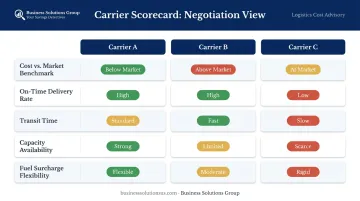
Building the Carrier Scorecard for Multi-Carrier Leverage
Presenting side-by-side carrier scorecards — cost, reliability, transit time, capacity availability — signals to the incumbent that alternatives have been evaluated. Carriers who know they're being benchmarked against competitors negotiate differently than carriers who assume they're the only option.
This tactic works best when the data is granular and recent. A carrier scorecard built on six-month-old data loses its credibility quickly. Real-time or near-real-time performance data is what makes the scorecard a negotiation tool rather than a historical summary.
Identifying Overbilling and Unclaimed Credits
According to AFMS, more than $2 billion in refunds and credits go unclaimed by U.S. businesses each year, with on-time service audits alone representing 1–3% in recoverable savings. Freight intelligence dashboards surface SLA violations, billing discrepancies, and volume discount thresholds that weren't reached — all of which represent either credits owed or contract term revisions to negotiate into the next cycle.
Business Solutions Group's spend intelligence platform tracks these recovery opportunities, flagging carrier compliance failures and billing errors through automated analysis so clients can enter the next negotiation cycle with documented findings rather than estimates.
The Four Pillars of Freight Contract Management
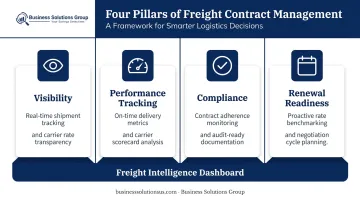
Freight intelligence dashboards don't just support negotiations — they underpin the entire contract management lifecycle across four interdependent pillars.
Visibility — All carrier agreements, rate structures, accessorial schedules, SLA terms, and renewal dates need to live in one place. Without this baseline, organizations cannot negotiate from a position of knowledge. A freight intelligence dashboard serves as the operational backbone of this layer.
Performance Tracking — Carrier performance monitoring, measured against contracted SLAs rather than general impressions, creates the documentation needed to enforce contract terms, pursue service credits, and make retention decisions at renewal. Timestamped performance records give shippers a defensible record in carrier conversations.
Compliance — Freight contracts increasingly include environmental, regulatory, and safety clauses that require ongoing monitoring across the contract lifecycle. Dashboards that surface compliance status across the carrier portfolio help shippers avoid penalties and confirm both parties are meeting their obligations.
Renewal Readiness — Organizations that treat renewals as a year-round process — continuously updating benchmarks, tracking performance, and flagging upcoming expirations — consistently outperform those that scramble at the last moment. Renewal readiness converts the annual renegotiation from a reactive scramble into a strategic review with evidence already in hand.
Common Mistakes Shippers Make Without Freight Intelligence
Three patterns appear repeatedly in freight procurement when intelligence tools are absent.
Relying on Historical Invoices Instead of Market Benchmarks
Many shippers evaluate whether their rates are reasonable by comparing this year's invoice to last year's — not against what the market is offering today. This is how shippers systematically overpay for years without realizing it.
Contract rates typically lag spot rates by 4 to 6 months, meaning the market has already moved before most contracted rates follow. During the 2022–2023 freight correction, contract rates negotiated by carriers were down 12% to 16% — but shippers without benchmark visibility had no way to quantify that gap or use it as leverage.
Allowing Contracts to Auto-Renew Without Renegotiation
Carrier contracts quietly roll over at existing rates when no one tracks the expiration date. Across multiple carriers and multiple renewal cycles, the compounding cost is significant. The shift in market preference toward shorter contract durations reflects this — 12-month freight contracts fell to just 43% of the market by 2024, while 3–6 month contracts rose to 26%, as shippers sought more frequent opportunities to reset rates to market.
A dashboard with active renewal tracking prevents this. In practice, "outdated contracts with overpriced rates" is one of the most preventable cost leaks in freight procurement — and one Business Solutions Group flags consistently across client audits.
Negotiating All Carriers the Same Way
Without lane-level data, procurement teams tend to apply the same approach across every carrier negotiation. The priorities and leverage points differ too much for that to work. Consider how differently two carriers might look side by side:
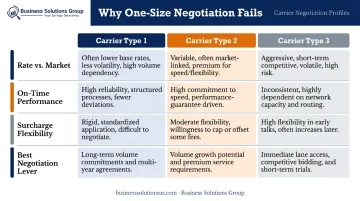
- One carrier delivers consistently but charges above-market rates on key lanes
- Another prices competitively but has persistent delivery failures on time-sensitive freight
- A third may dominate regionally but offer no flexibility on fuel surcharges
Tailored, lane-specific negotiation produces better outcomes than blanket rate discussions — but only if you have the data to drive it.
How to Choose the Right Freight Intelligence Solution
Evaluate Benchmark Data Quality First
The core value of any freight intelligence solution is its market rate data. Shippers should assess:
- How frequently benchmarks are updated (daily vs. monthly matters significantly)
- How many data points underpin the benchmarks — DAT RateView, for example, is powered by more than $1 trillion in transactions
- Whether the data covers their specific trade lanes, modes, and service types
Generic or outdated benchmarks undermine the negotiation value the tool is supposed to create. A benchmark built on insufficient data generates false confidence, which is more dangerous than having no benchmark at all.
Assess Integration and Workflow Depth
A freight intelligence dashboard only delivers full value when it connects to existing TMS, ERP, and contract management systems. Isolated tools that require manual data uploads recreate the version control and visibility problems they're supposed to solve. Look for solutions that integrate rate data directly into booking and invoice validation workflows, not just reporting screens.
Look for Advisory Support Alongside the Technology
Even the best benchmark data requires interpretation to drive real negotiation outcomes. For shippers without dedicated in-house procurement expertise, knowing the gap exists is only half the work — closing it requires experience with carrier leverage points, contract structure, and timing.
Business Solutions Group pairs proprietary spend intelligence software with hands-on advisory services so freight and parcel shippers can translate their data into concrete carrier contract improvements. Rather than delivering a report and stepping back, the advisory layer helps shippers act on what the data surfaces. Shippers interested in understanding where their current contracts stand can request a complimentary benchmark savings analysis at businesssolutionsus.com.
Frequently Asked Questions
What are the key pillars of contract management?
The four pillars are visibility into all contracts and terms, ongoing carrier performance tracking against SLAs, compliance monitoring across the carrier portfolio, and proactive renewal management. Freight intelligence dashboards support all four by centralizing data and flagging performance gaps and upcoming expirations in one view.
What data should a freight intelligence dashboard show?
At minimum: lane-level rate benchmarks compared to market averages, carrier performance scores (on-time delivery, damage rates, SLA compliance), total spend by carrier and mode, accessorial and surcharge trends tracked separately from base rates, and contract expiration timelines with renewal alerts.
How do freight intelligence dashboards reduce carrier costs?
They surface lanes where contracted rates exceed market benchmarks, give shippers documented evidence to challenge pricing, and identify overbilling or unclaimed SLA credits. Collectively, these capabilities enable measurable cost reductions at renewal rather than accepting carrier-proposed increases without challenge.
What is the difference between contract rates and spot rates in freight?
Contract rates are pre-negotiated for a set period in exchange for volume commitments. Spot rates reflect one-off market prices for individual shipments. Because contract rates typically lag spot rates by 4–6 months, freight intelligence data that tracks both helps shippers time negotiations and benchmark against current market conditions.
How often should freight contracts be renegotiated?
Annual renegotiation aligned to contract renewal dates is standard practice. However, dashboards that track market rate movements can signal when mid-cycle renegotiation is warranted — particularly when fuel costs shift significantly or spot rates diverge sharply from contracted levels.
Can small and mid-sized shippers benefit from freight intelligence dashboards?
They typically lack dedicated analytics teams and are most vulnerable to overpaying — freight forwarders on average pay 21.3% less than shippers who negotiate without market data. Intelligence tools close that gap by giving smaller shippers the same benchmarking leverage as larger competitors.