This is the everyday reality for companies that manage freight contracts reactively — treating signed agreements as filing tasks rather than active cost controls. The difference between reactive and strategic contract management shows up directly on the P&L.
This article breaks down what freight contract management actually involves, where companies consistently lose money by getting it wrong, and what best practices look like heading into 2026 — a year when tariff volatility, sustainability mandates, and tighter carrier markets are raising the stakes.
Key Takeaways
- Freight contract management covers the full lifecycle of carrier agreements (negotiation, execution, monitoring, and renewal) and directly shapes transportation costs and service quality
- Poor contract visibility and missed renewal windows are among the most costly and preventable mistakes freight shippers make
- According to FreightWaves, streamlining freight procurement workflows can reduce full truckload spend by 2–3%, with strategic carrier selection reducing spot-market exposure by 10–25%
- In 2026, tariff volatility, ESG obligations, and carrier market shifts make proactive contract management more critical than ever
What Is Freight Contract Management (and Why Most Companies Get It Wrong)
Freight contract management is the end-to-end process of negotiating, executing, monitoring, and renewing agreements between shippers and carriers. It covers base rates, fuel surcharge structures, accessorial fees, service level agreements, compliance obligations, and renewal terms. Most companies, however, treat it like exactly that.
Once signed, contracts get saved to a shared drive or buried in an email thread — and nobody revisits them until something goes wrong. Daily routing decisions, invoice approvals, and carrier interactions all proceed without any active connection to what was actually negotiated.
The Cost of Disconnected Contracts
This gap between what's in the contract and what's operationally practiced is known as contract leakage — and it's expensive. World Commerce & Contracting reports that organizations lose an average of 11% of contract value through value leakage across procurement agreements. In freight, where contracts govern complex multi-variable pricing across dozens of lanes and service types, those losses are even harder to catch manually.
Contract leakage in freight takes several forms:
- Paying rates above what was contractually negotiated
- Missing SLA service credits because claims weren't filed
- Absorbing accessorial charges that fall outside contracted terms
- Failing to trigger volume discount thresholds that were negotiated but never operationalized
Closing these gaps requires more than better filing. Effective freight contract management runs on three connected practices:
- Visibility — knowing exactly what's in every active contract
- Monitoring — tracking carrier performance against those terms in real time
- Renewal planning — entering renegotiations with performance data, not assumptions
Without all three working together, even well-negotiated contracts erode in value.
Common Types of Freight Contracts Every Shipper Should Know
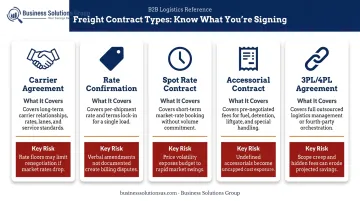
Most shippers juggle at least four or five contract types at once — each with a distinct cost structure and failure mode.
| Contract Type | What It Covers | Key Risk |
|---|---|---|
| Carrier Agreement | Master terms governing the carrier relationship — liability, dispute resolution, general obligations | Broad language that favors the carrier if left unreviewed |
| Rate Confirmation | Locked lane pricing for a defined period, tied to volume commitments | Rates become uncompetitive as market conditions shift |
| Spot Rate Contract | One-off shipment pricing at real-time market rates | Higher cost per shipment; overreliance inflates freight spend |
| Accessorial Contract | Detention fees, fuel surcharges, special handling, delivery area charges | Charges accumulate quickly and shippers rarely audit them |
| 3PL/4PL Agreement | Terms for outsourced logistics management including fulfillment and transportation | Stacked margins and reduced shipment-level visibility |
Why Accessorials Deserve Specific Attention
Accessorial charges are a persistent source of cost overruns that shippers underestimate. FreightWaves reports that accessorials can account for up to 40% of a typical commercial parcel delivery charge, with LTL accessorials adding roughly 5% to the typical total bill.
Fuel surcharges, dimensional weight penalties, delivery area surcharges, and residential fees stack on top of each other — and that compounding adds up fast. Most shippers spend time negotiating base rates but never verify whether the accessorial terms in their agreements are being applied correctly in the first place.
Managing these five contract types in isolation — across different teams, systems, or email threads — is exactly what creates billing disputes, missed deadlines, and compliance exposure. A single shared view of all active agreements makes it possible to catch those errors before they become invoices.
The Hidden Costs of Poor Freight Contract Management
Missed Renewals and Auto-Rollovers
Freight contracts frequently auto-renew at existing rates unless a shipper initiates renegotiation in advance. Without a renewal calendar and advance alerts — ideally 90–120 days before expiration — shippers lose negotiating leverage entirely and remain locked into terms that no longer reflect market conditions.
Manual tracking through spreadsheets and email reminders is unreliable. When renewals slip through, the organization doesn't just miss a better rate — it concedes the window to benchmark the carrier's performance and prepare a data-driven counterproposal.
Rate Complexity and Uncaptured Savings
Freight pricing is multi-layered, and the gaps are easy to miss:
- Base linehaul rates that shift between lanes without notice
- Fuel surcharge indices that can drift in the carrier's favor mid-contract
- Volume discount tiers that never get applied correctly during peak season
- Accessorial schedules that accumulate charges shippers didn't anticipate
Without systematic invoice-level tracking, the gap between what was negotiated and what was actually paid stays invisible. Shippers often pay more than their contracts entitle them to — and never know it.
SLA Non-Enforcement
Many shippers negotiate meaningful service level agreements — on-time delivery windows, damage liability caps, claims credit triggers — but never enforce them. Process friction is usually why: filing for service credits requires documentation that takes time to compile, and operations teams prioritize moving freight over chasing credits.
Credits the shipper is contractually entitled to go unclaimed, and carriers have no performance accountability because consequences never materialize. The result is direct cost leakage that compounds quietly over every contract cycle.
Operational Disconnection
Procurement negotiates favorable rates. Operations continues routing shipments through existing habits or outdated systems. The contract terms remain trapped in a PDF, never flowing into booking decisions or invoice validation.
Business Solutions Group identifies this as one of the most common challenges freight shippers face. Shipping data is scattered across invoices, carrier portals, internal systems, and spreadsheets — making it nearly impossible to connect daily shipping decisions to what the contract actually allows.
Connecting routing logic to contracted rates and automating invoice validation is how negotiated savings actually reach the bottom line.
Compliance Risk Exposure
Modern freight contracts increasingly include clauses tied to hours-of-service regulations, fuel efficiency standards, and carbon emissions reporting. Non-compliance can expose shippers to regulatory penalties even when the carrier is the responsible party — particularly when contracts create shared obligations.
Without ongoing monitoring throughout the contract lifecycle, compliance gaps only surface at audit time, when remediation is expensive and options are limited.
Best Practices for Freight Contract Management in 2026
Build a Centralized Contract Repository
Every freight agreement — carrier contracts, rate sheets, BOLs, accessorial term sheets — should live in a single searchable system of record. Not email, not a shared folder, not a spreadsheet tab.
A centralized repository delivers three immediate benefits:
- Eliminates version confusion — everyone in legal, finance, and operations works from the same current document
- Accelerates audits — invoice discrepancies can be traced back to exact contract language quickly
- Enables proactive management — renewal dates, SLA triggers, and compliance obligations are visible before they become problems
Establish a Proactive Renewal Calendar
Set 90–120 day pre-expiration alerts for every freight contract. Use that window to:
- Benchmark current rates against market conditions and comparable lanes
- Compile carrier performance data — on-time rates, damage frequency, invoice accuracy
- Build a negotiation playbook built on documented performance gaps and internally verified data
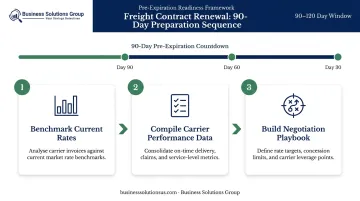
Shippers who enter renewals with 90 days of preparation consistently negotiate better outcomes than those who respond at expiration. The 90-day window is the difference between negotiating from preparation and accepting whatever the carrier proposes.
Negotiate with Data, Not Assumptions
Shippers who enter carrier negotiations with documented performance metrics hold a stronger position than those relying on instinct or carrier-supplied proposals. The metrics that matter most:
- On-time delivery rate by lane and service level
- Damage and claims frequency
- Invoice accuracy variance (contracted vs. billed)
- SLA credit capture rate
Benchmark analysis — comparing current rates against market or industry standards — is one of the most effective tools in this process. Business Solutions Group provides benchmark analysis and advisory services that show freight and parcel shippers exactly where their carrier pricing stands against market rates — so they walk into negotiations with independent data, not guesswork.
Standardize Contract Templates and Clause Libraries
Pre-approved freight contract templates with standardized language for SLAs, fuel surcharge adjustment mechanisms, liability caps, and renewal notice periods reduce drafting errors and accelerate approval cycles. They also ensure compliance requirements aren't accidentally omitted when agreements are renewed or modified.
Consistency across contracts makes monitoring easier — when SLA language is standardized, tracking performance against it becomes systematic rather than contract-by-contract interpretation work.
Monitor Carrier Performance Continuously
Contract performance monitoring shouldn't wait for renewal. Establish quarterly reviews that track:
- On-time delivery rate by carrier and lane
- Variance between contracted and invoiced rates (including accessorials)
- SLA credit capture rate
- Cost per lane versus benchmark
- Dispute frequency and average resolution time
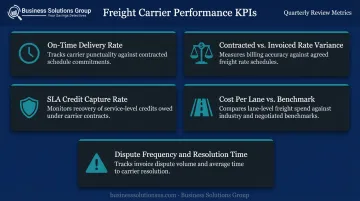
Quarterly reviews create a feedback loop: carriers know they're being measured, performance accountability increases, and the data generated becomes the foundation for every future negotiation.
Why Freight Contract Management Is More Critical Than Ever in 2026
Tariff Volatility Is Reshaping Rate Stability
The freight rate environment heading into 2026 is unusually volatile. Cass Information Systems reported that freight rates rose 5.0% year over year in May 2025, driven partly by tariff-related demand shifts and a push toward truckload mix. The US-China tariff truce in May 2025 cut US tariffs on Chinese goods from 145% to 30%. Ocean and domestic trucking rates were projected to surge immediately as shippers moved freight through that temporary window.
For shippers without active contract management, this volatility is damaging. Contracts locked at pre-surge rates offer protection — but only if those contracts are actively monitored and enforced. Shippers relying on spot markets absorb the full impact of every rate spike.
The ESG Compliance Burden Is Growing
Sustainability and carbon reporting requirements are increasingly embedded in freight contracts, particularly for companies with enterprise or retail customers that have their own Scope 3 emissions commitments. Only 13% of buyers included climate-related requirements in supplier contracts in 2024, according to BSR — but that number is rising as ESG disclosure expectations spread through supply chains.
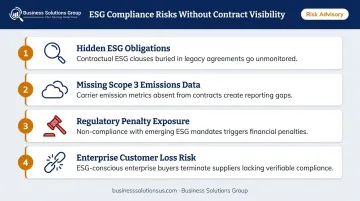
Without contract visibility, shippers face compounding risks:
- Can't confirm whether existing agreements contain ESG obligations
- Unable to pull emissions data for Scope 3 reporting
- Exposed to regulatory penalties as carbon disclosure requirements formalize
- Risk losing enterprise customers whose own ESG commitments flow down to suppliers
Technology Is Now a Baseline, Not a Differentiator
Descartes' 2025 Transportation Management Benchmark Survey found that 43% of respondents still used spreadsheets and email for shipment visibility, with only 17% fully automated. In 2026, organizations still managing freight contracts through manual processes are leaving measurable savings on the table and taking on avoidable compliance risk.
Closing that gap requires connecting contracted rates directly into booking decisions and invoice validation — so negotiated savings show up in actual invoices, not just in spreadsheet projections. Business Solutions Group's spend intelligence software and eProcurement solutions are built specifically for this: giving freight shippers the visibility to move from reactive firefighting to proactive contract management.
Frequently Asked Questions
What is freight contract management?
Freight contract management is the end-to-end process of negotiating, monitoring, and renewing carrier agreements to control transportation costs, enforce service standards, and maintain regulatory compliance. It covers the full contract lifecycle — from rate negotiation through performance tracking and renewal — not treating agreements as static documents.
What is the difference between CLM and ERP?
Contract Lifecycle Management (CLM) software handles contracts specifically: drafting, negotiation, execution, and performance monitoring. ERP systems manage broader operations like finance, inventory, and HR. The two integrate well, with CLM feeding contracted rates and terms into ERP or TMS platforms for day-to-day operational use.
What's the difference between spot rates and contract rates in freight?
Spot rates are real-time, one-off market prices for individual shipments — practical for urgent or irregular needs, but typically more expensive than contracted rates. Contract rates lock agreed pricing for a defined period in exchange for volume commitments. As of February 2026, truckload spot rates averaged $2.01 per mile versus contract rates of $2.12 per mile — though the relationship varies significantly by mode, lane, and market conditions.
How often should freight contracts be renegotiated?
Most freight contracts align with annual renewal cycles, making that the natural renegotiation point. That said, significant fuel cost swings, sustained performance issues, major volume changes, or major tariff shifts can justify mid-contract discussions. This is especially true when the original terms included adjustment clauses for those scenarios.
What KPIs should be tracked to measure freight contract performance?
Core metrics to track:
- On-time delivery rate by carrier and lane
- Variance between contracted and actual invoiced rates (including accessorials)
- SLA credit capture rate
- Dispute frequency and average resolution time
- Percentage of freight spend under contract versus spot
Reviewing these quarterly gives shippers the data to hold carriers accountable and enter renewals with documented evidence.