Introduction
Managing shipping IT is messier than most operations teams want to admit. Carrier tracking systems, order management tools, freight invoicing platforms, and compliance requirements rarely talk to each other—and many still run on aging on-premise hardware that requires dedicated staff just to keep running.
The overhead is real. The BLS reports network and computer systems administrators earned a median annual wage of $96,800 in May 2024—and that's before factoring in hardware refresh cycles, data center costs, and the manual work that siloed systems generate every day.
Cloud platforms cut through this complexity. By centralizing operations and automating repetitive workflows, they reduce the IT burden and the operational drag that fragmented systems create.
This article covers the four cloud service models shippers should understand, how cloud adoption simplifies day-to-day IT management, the measurable business benefits, and how to choose the right platform for your operation.
Key Takeaways
- Cloud platforms replace on-premise infrastructure with scalable, subscription-based solutions built for shipping workflows
- IaaS, PaaS, SaaS, and FaaS each serve different operational needs—SaaS is where most shippers start
- Real-time visibility, carrier integration, and automated workflows reduce both IT overhead and manual errors
- Match cloud capabilities to your shipping volume, carrier mix, and integration needs before committing to a platform
The IT Challenges Shippers Face Without Cloud Platforms
Fragmented, on-premise systems create compounding problems for shippers — and cloud platforms are built to address each one.
On-premise infrastructure costs outpace what most shippers can absorb. Maintaining physical servers, managing software licenses, and keeping an IT team on staff to handle updates and outages is expensive—especially for small and mid-size shippers whose freight spend doesn't justify enterprise-scale infrastructure overhead.
Disconnected platforms turn routine data into a manual burden. When order management, carrier tracking, and freight invoicing run on separate systems, data doesn't travel cleanly between them. Staff manually re-enter information, exceptions fall through the cracks, and decisions get made on stale data.
The downstream impact shows up on invoices. According to FreightWaves, freight invoice audits routinely uncover overcharges, duplicate invoices, incorrect weight/dimension charges, misclassified freight, and unauthorized accessorial fees—problems that are far harder to catch without a centralized system.
Without consolidated spend data, rate negotiations stall. Shippers can't easily compare carrier performance, identify billing patterns, or build the financial case needed for contract renegotiations. Recoverable savings stay unrecovered.
MHI and Deloitte project cloud computing and storage adoption in supply chains will reach 91% by 2029. Companies still running legacy infrastructure are increasingly in the minority—and falling further behind on visibility, automation, and cost control.
The 4 Types of Cloud Services Shippers Should Know
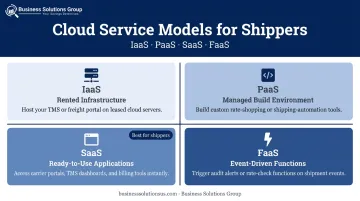
Not all cloud services work the same way. Understanding these four models helps shippers select the right tools for each operational need rather than defaulting to whatever a vendor recommends.
Infrastructure-as-a-Service (IaaS)
IaaS provides rented computing infrastructure—servers, storage, and networking—over the internet. For shippers, this eliminates the need to purchase and maintain physical hardware for running logistics software. AWS EC2 delivers on-demand, scalable compute capacity; DigitalOcean offers similar on-demand compute, networking, and storage.
Best for: Hosting custom logistics applications, integration engines, and analytics workloads.
Platform-as-a-Service (PaaS)
PaaS provides a managed environment for building and deploying applications without managing the underlying hardware. Developers can build carrier portals, custom dashboards, and API connections without worrying about server configuration. Microsoft Azure App Service is a common example. It's the right fit for shipping companies building custom integrations or internal analytics tools.
Software-as-a-Service (SaaS)
SaaS is the most relevant model for most shippers. It delivers ready-to-use software via a browser—no installation, no patching, no version management. Transportation management systems (TMS), freight audit tools, and carrier rate comparison platforms all typically operate as SaaS.
The practical upside: IT teams stop scheduling maintenance windows and managing update compatibility. The software vendor handles all of that automatically.
Best for: TMS deployment, freight audit, parcel shipping management, and carrier rate visibility.
Function-as-a-Service (FaaS)
FaaS runs specific code functions only when triggered by an event—for example, a shipment status change automatically triggers a customer notification. The code runs, then stops; there's no always-on server consuming resources. PostNL, the Dutch postal carrier, adopted a 100% cloud strategy in 2012 and closed its last data center in 2017. The company treated serverless/FaaS architecture as a strategic pillar for its logistics operations.
Most shippers won't manage FaaS directly, but many cloud shipping platforms rely on it to reduce latency and cost on event-driven workflows.
How Cloud Platforms Simplify Shipping IT Management
The operational impact of cloud adoption extends well beyond infrastructure savings. Here's how it changes day-to-day IT management for shipping teams.
Real-Time Shipment Visibility and Data Access
Cloud platforms consolidate shipment data from multiple carriers and warehouses into a single dashboard. Operations teams get real-time visibility into shipment status, delivery exceptions, and inventory levels—accessible from any device, anywhere, without VPN dependencies or local server access.
This matters most during disruptions. When a carrier delay triggers a cascade of exceptions, teams with a centralized cloud view can triage and respond faster than those pulling data from three separate systems.
Automated Workflows and Reduced Manual Work
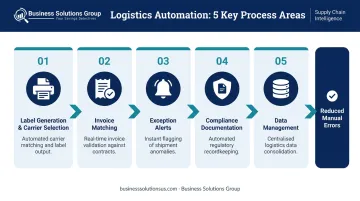
Cloud-based shipping platforms automate the repetitive tasks that consume disproportionate staff time:
- Label generation and carrier selection at order processing
- Invoice matching against contracted rates
- Exception alerts when shipments deviate from expected delivery windows
- Compliance documentation across carriers and lanes
APQC identifies shipment scheduling, tracking, data management, inventory management, and order fulfillment as key logistics areas where automation delivers efficiency gains. The practical result is fewer manual errors and staff time redirected toward higher-value work.
Carrier and Vendor Integration Without the Maintenance Burden
Modern cloud shipping platforms connect via APIs to dozens of carriers—UPS, FedEx, regional carriers—as well as warehouse management systems and ERPs. This eliminates the point-to-point integration maintenance that plagues on-premise setups, where every carrier connection or system update potentially breaks something else.
Pre-built API frameworks mean new carrier connections can be activated in days, not months.
Scalability During Peak Shipping Seasons
Peak season is where on-premise infrastructure shows its limits most visibly. ShipMatrix estimated 2.3 billion packages would be delivered during peak 2025—5% above peak 2024—with more than 568 million parcels processed in the first week of December alone, roughly 30% above off-peak volume.
No shipper should buy hardware sized for those peak weeks and have it sit underutilized the rest of the year. Cloud platforms scale compute resources up and down with demand, handling holiday surges without additional hardware purchases or year-round overprovisioning.

Automatic Updates and Reduced IT Overhead
SaaS platforms push software updates, security patches, and compliance changes automatically—without scheduled maintenance windows or version compatibility headaches. IT teams skip the update cycle entirely and redirect that time toward projects that actually move the business forward. For shipping operations, that typically means better data governance, tighter carrier integrations, and faster exception resolution.
Key Benefits of Cloud Adoption for Shipping Businesses
Lower Total Cost of Ownership
Shifting from on-premise hardware to subscription-based cloud services converts fixed capital expenditure into variable operating expenses that scale with business activity. When volume drops, so does spend. When volume grows, capacity expands without procurement delays.
General cloud benchmarking data supports the directional case: AWS-cited research shows organizations achieved a 20% decrease in total technology infrastructure costs, with top performers seeing up to 47% in savings. These are broad benchmarks rather than logistics-specific guarantees, but the underlying economics—eliminating hardware refresh cycles, data center overhead, and dedicated IT staffing—apply clearly to shipping operations.
Improved Carrier Contract Performance and Spend Visibility
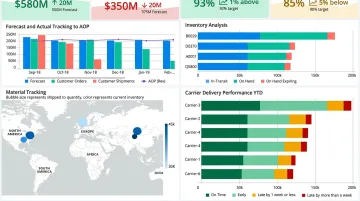
Cloud-based analytics give shippers the consolidated data needed to benchmark carrier performance, catch billing discrepancies, and identify rate optimization opportunities. Without centralized data, those opportunities stay invisible.
That's where cloud tools and advisory expertise reinforce each other. Business Solutions Group pairs proprietary parcel spend intelligence software with hands-on advisory services. They benchmark client rates against market data, model proposed carrier pricing before contract signing, and build the financial case needed to negotiate from strength. Their work with UPS and FedEx small parcel contracts has delivered typical savings of 15% to 40%—an average of 23.6% year-to-date across their client base, with over $1 billion recovered collectively.
Enhanced Data Security and Business Continuity
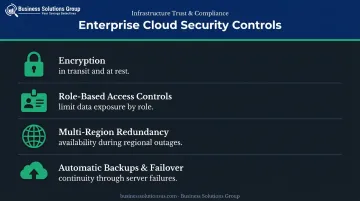
Enterprise cloud providers implement security controls that most small and mid-size shippers cannot replicate on their own hardware:
- Encryption in transit and at rest
- Role-based access controls limiting data exposure by user role
- Multi-region data redundancy ensuring availability during regional outages
- Automatic backups and failover that keep operations running through server failures
AWS SOC reports undergo independent third-party examination. Azure SOC 2 Type 2 reports map to security, availability, processing integrity, and confidentiality. Both platforms hold ISO/IEC 27001:2022 certification.
For shippers evaluating platforms, NIST's guidance on public cloud security remains relevant. Cloud providers offer stronger tooling, but organizations retain accountability for how they configure it.
The stakes are high. IBM's 2025 report put the global average data breach cost at $4.44 million. That's a number most small and mid-size shippers cannot absorb, and cloud-grade security significantly reduces the exposure.
Better Collaboration Across Teams and Partners
Cloud platforms enable real-time data sharing between internal teams and external partners alike. On the internal side, that means operations, finance, and customer service working from the same live data. Externally, it connects carriers, freight brokers, and customs agents through shared portals and API-linked workflows.
The result: email chains and spreadsheet handoffs give way to synchronized decisions—with no version-control confusion slowing things down.
How to Choose the Right Cloud Platform for Your Shipping Business
Not all cloud shipping platforms are built for the same use case. Evaluation should start with your operational profile: shipping volume, carrier diversity, integration requirements, and whether you need a standalone TMS or a more comprehensive supply chain platform.
Key Evaluation Criteria
| Criterion | What to Look For |
|---|---|
| Carrier integration | Pre-built connections to your primary carriers; open API framework for others |
| Scalability | Documented ability to handle peak volume spikes without performance degradation |
| Total cost | Subscription fees plus implementation costs, per-shipment fees, and support tiers |
| Security certifications | SOC 2 Type 2 compliance; ISO/IEC 27001; data residency policies |
| Reporting and analytics | Spend visibility by carrier, lane, and service level; billing discrepancy detection |
| Customer support | Response SLAs, implementation assistance, and onboarding resources |
On the vendor side, Oracle and SAP both held Leader recognition in the 2025 Gartner Magic Quadrant for Transportation Management Systems—Oracle for the 18th consecutive time, SAP for the 11th. Microsoft Dynamics 365 Supply Chain Management includes transportation management capabilities with broader ERP integration. Specialized logistics SaaS tools offer faster deployment for shippers who don't need full enterprise ERP scope.
Working with an Advisory Partner
A cloud platform delivers the data. Converting that data into contracted savings is a separate step—one that requires carrier market knowledge and negotiation expertise.
For shippers managing complex carrier networks or significant freight spend, Business Solutions Group combines cloud-based spend intelligence with direct advisory support. Their engagement starts with a no-cost savings analysis that benchmarks current rates, models proposed carrier pricing, and builds the negotiation framework needed to act on the findings.
For shippers that haven't done systematic carrier contract analysis, the gap between current rates and optimized rates is typically more significant than anticipated—and closing it starts with knowing where you stand.
Frequently Asked Questions
What are the 4 types of cloud services?
The four models are IaaS (raw infrastructure), PaaS (managed platforms), SaaS (ready-to-use applications), and FaaS (event-driven code execution). For most shipping businesses, SaaS is the most immediately relevant, delivering logistics software via the browser without installation or server management.
What is the best shipping management software?
The best platform depends on your shipping volume, carrier mix, and integration requirements. Enterprise options include Oracle Transportation Management, SAP TM, and Microsoft Dynamics 365 Supply Chain Management; specialized SaaS tools offer faster deployment for mid-market shippers. Evaluate based on pre-built carrier connections, analytics depth, and total cost of ownership.
How do cloud platforms help reduce shipping costs?
Cloud platforms consolidate carrier data, contract rates, and shipment spend into a single view—making it practical to spot billing errors, benchmark carrier performance, and identify routing inefficiencies. Combined with advisory expertise, that visibility drives negotiated rate reductions and recovered overcharges.
Is cloud-based shipping software secure enough for sensitive logistics data?
Enterprise cloud providers implement encryption, role-based access controls, and redundant backups that typically exceed what small and mid-size shippers can build and maintain on-premise. When evaluating platforms, verify SOC 2 Type 2 compliance, ISO/IEC 27001 certification, and data residency policies before signing.
Can small parcel shippers benefit from cloud platforms, or are they only for large enterprises?
Cloud platforms are particularly valuable for smaller shippers because they eliminate upfront infrastructure investment. Subscription-based access means a mid-size parcel shipper can use the same analytics and carrier integration capabilities as a large enterprise—without the capital outlay or IT headcount.
What is the difference between cloud-based and on-premise shipping software?
On-premise software runs on company-owned servers and requires internal IT teams to manage updates, security, and maintenance. Cloud-based software is hosted by the vendor and accessed via the internet, offering lower upfront costs, automatic updates, and access from any device. For most shippers, the operational flexibility and reduced IT overhead make cloud the more practical long-term choice.